The Complete Guide to Optometry Services in North Hollywood: What to Expect, What to Pay, and How to Choose”
Walking into an optometry office for the first time—or switching after years with the same provider—can feel overwhelming. Whether you’re a creative professional in the NoHo Arts District dealing with digital eye strain, a parent managing your child’s first vision screening, or a senior navigating Medicare coverage, understanding what optometry services actually entail (and what they should cost) is essential.
In North Hollywood’s diverse landscape—where 46.4% of residents are foreign-born and the median age is 36.8—the demand for transparent, culturally competent eye care has never been higher. This guide cuts through the confusion, providing specific pricing, scientific insights, and local context you won’t find in generic “what to expect” articles.
Quick Guide Overview
- Comprehensive eye exams: $100 at independent practices vs $50-$100 at chains
- Medicare covers medical eye exams (diabetes/glaucoma) but not routine vision checks
- Contact lens fittings cost $150-$190 depending on complexity
- North Hollywood optometrists serve diverse needs from entertainment industry workers to families
What Is Optometry? Understanding Eye Care in North Hollywood
Optometry is primary eye health care focused on examining, diagnosing, treating, and managing diseases and disorders of the visual system. In North Hollywood, optometrists serve as the first line of defense for everything from routine vision correction to early detection of diabetes and hypertension.
The Difference Between Optometrists and Ophthalmologists
The distinction matters for your wallet and your health outcomes:
|
Provider Type |
Education |
What They Do |
|---|---|---|
|
Optometrist (OD) |
4 years optometry school post-undergraduate |
Comprehensive eye exams, glasses/contacts prescriptions, medical eye care (dry eye, infections), disease detection |
|
Ophthalmologist (MD) |
4 years medical school + 3-4 year residency |
Medical and surgical eye care, complex disease treatment, cataract/glaucoma surgery |
For 90% of North Hollywood residents, an optometrist serves as their primary eye care provider, referring to ophthalmologists only when surgical intervention is necessary.
Expert Insight: “By the end of four years [of medical school], medical students must decide if they want to focus on general internal medicine, family practice, surgery or some subspecialty… It is in residency that future ophthalmologists are fully immersed in taking care of the eye and visual systems, and they also learn how to do eye surgery.” — Dr. Jo Ann Giaconi, Ophthalmologist, UCLA Stein Eye Institute
Why North Hollywood’s Demographics Shape Local Eye Care
North Hollywood’s unique population creates specific eye care demands:
- Entertainment Industry Concentration: High screen exposure (video editing, post-production) correlates with increased dry eye disease. Research shows 4+ hours of daily screen use increases dry eye risk by 40% (PubMed, 2020).
- Aging Population: Valley Village/North Hollywood has significant senior communities requiring Medicare navigation and presbyopia management.
- Diverse Income Levels: With median household income at $71,752 (slightly above LA County average) but 16.4% below poverty line, transparent pricing is essential.
- Geographic Spread: From the dense NoHo Arts District to suburban Valley Glen, accessibility and parking are practical concerns.
What Happens During a Comprehensive Eye Exam
A comprehensive eye exam at a North Hollywood optometry practice like Lens Factory is not a “vision screening”—it’s a thorough health assessment of your visual system. Here’s the complete breakdown:
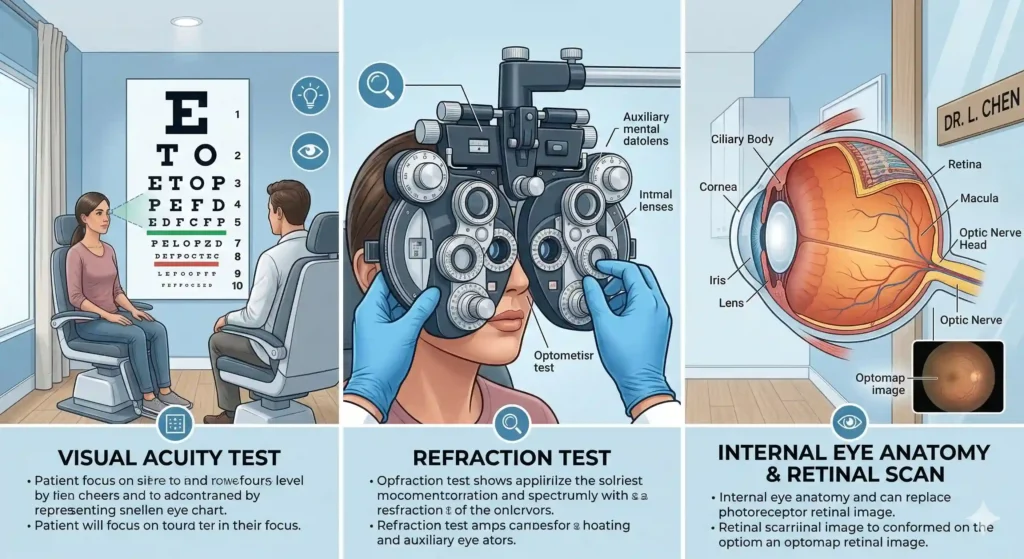
The 8 Essential Tests Explained
1. Patient History & Symptoms (5 minutes)
Your optometrist reviews medical history, medications (some affect vision), family history of eye disease, and current symptoms. Bring a list of current medications and your insurance card.
2. Visual Acuity Testing (5 minutes)
The classic “read the smallest line” test using a Snellen chart. Measures clarity at various distances.
3. Refraction Assessment (10-15 minutes)
Using a phoropter (the “which is better, 1 or 2?” device), your doctor determines your exact prescription for nearsightedness, farsightedness, or astigmatism.
4. Eye Muscle Function & Binocular Vision (5 minutes)
Tests how well your eyes work together. Poor coordination can cause headaches, double vision, and reading difficulties—particularly relevant for children and office workers.
5. Pupillary Response Evaluation (2 minutes)
Checks how pupils react to light, which can reveal neurological issues.
6. Slit-Lamp Examination (5-10 minutes)
A microscope examination of the front of your eye—cornea, iris, lens, and anterior chamber. Detects cataracts, corneal abrasions, and infections.
7. Tonometry (Glaucoma Screening) (2 minutes)
Measures intraocular pressure. The “puff of air” test (non-contact tonometry) is common, though Goldman applanation (using numbing drops) is more accurate for at-risk patients.
8. Retinal Examination (5-15 minutes)
Using ophthalmoscopy, your doctor examines the retina, optic nerve, and blood vessels at the back of your eye. This detects diabetic retinopathy, macular degeneration, and hypertension-related changes.
Optional: Dilation (DFE – Dilated Fundus Exam)
Drops enlarge pupils for a wider retinal view. Adds 30 minutes to appointment time (blurry near vision persists 3-6 hours). Recommended annually for patients over 60, diabetics, or those with high blood pressure. Cost: $30 at Lens Factory.
How Long Does an Eye Exam Take?
|
Exam Type |
Duration |
Best For |
|---|---|---|
|
Standard Comprehensive |
30-45 minutes |
Adults 18-60 with no risk factors |
|
Comprehensive + Dilation |
60-75 minutes |
Seniors, diabetics, high blood pressure |
|
Pediatric Exam |
20-45 minutes |
Children (varies by age/cooperation) |
|
Contact Lens Fitting |
45-75 minutes |
First-time wearers or new prescriptions |
Insider Tip: At Lens Factory Optometry on Victory Boulevard, Dr. Domenic Colabella personally conducts all examinations—no delegation to technicians. This ensures consistency but means appointments run precisely on schedule. Arrive 15 minutes early for paperwork.
Eye Exam Costs in North Hollywood: 2026 Pricing Guide
Transparency in healthcare pricing is rare. Here’s exactly what you’ll pay at North Hollywood optometry practices:
Independent Optometrist vs. Retail Chain vs. Online
|
Service |
Independent (Lens Factory) |
Retail Chain (LensCrafters) |
|---|---|---|
|
Comprehensive Eye Exam |
$100 |
$85-$150 |
|
Contact Lens Fitting (Standard) |
$150 |
$100-$200 |
|
Toric (Astigmatism) Fitting |
$170 |
$150-$250 |
|
Multifocal (Presbyopia) Fitting |
$190 |
$150-$300 |
|
Dilation (DFE) |
$30 |
Often included |
|
DMV Vision Test |
$30 |
$25-$40 |
|
Retinal Imaging (Optos) |
$35-$40 |
$30-$50 |
Analysis: While Costco offers the lowest exam prices, their contact lens fitting options are limited (basic spherical lenses only). Independent practices like Lens Factory provide specialized fittings (toric, multifocal) and medical optometry services (diabetic exams, glaucoma management) that retail chains cannot offer.
What’s Included in the $100 Exam Fee at Lens Factory
- Complete medical history review
- All 8 diagnostic tests listed above
- Digital retinal imaging (Optomap) option ($35 additional)
- Detailed explanation of findings in “plain, simple language”
- Copy of your prescription (federally required, even if you don’t buy glasses)
- Follow-up consultation if issues are detected
- Coordination with ophthalmologists if specialist care is needed
No Hidden Fees
The $100 covers everything medically necessary for a comprehensive evaluation. Unlike some practices that advertise low exam fees then add charges for retinal imaging ($30-$50) or follow-up visits ($40-$75), our pricing is transparent.
Insurance Navigation for North Hollywood Residents
Understanding vision insurance prevents surprise bills. Here’s how major plans work in North Hollywood:
Understanding VSP Coverage
VSP (Vision Service Plan) is the largest vision insurer in California, covering many Warner Bros., Disney, and entertainment industry employees.
- Exam Copay: $15-$25 (plan dependent)
- Frame Allowance: $150-$250 annually
- Contact Lens Allowance: $120-$200 annually (can be used for lenses OR fitting fee)
- Lens Copays: $0-$50 depending on materials (anti-reflective, progressive, etc.)
Premier Edge Locations: Lens Factory is a VSP Premier Edge provider, offering enhanced benefits including additional $49 savings on retinal screening and priority scheduling.
Critical Distinction: VSP covers the contact lens fitting (professional service) OR the contact lens materials (the actual lenses), but not both at 100%. Most patients use the allowance for materials and pay the fitting fee separately ($150-$190).
Medicare Vision Coverage: What Seniors Actually Get
Original Medicare (Parts A & B):
- Does NOT cover: Routine eye exams, eyeglasses, contact lenses
- DOES cover: Annual glaucoma screening (high-risk), annual diabetic retinopathy exam (diabetics), macular degeneration testing, cataract surgery
Medicare Advantage (Part C): May include routine vision benefits ($100-$200 annual allowance). Varies by plan.
Cost Reality: With Original Medicare, you pay 20% coinsurance for covered services after meeting Part B deductible ($257 in 2025). For routine exams, expect to pay 100% out-of-pocket ($100-$150) unless you have supplemental vision coverage.
Do You Need Vision Insurance? Break-Even Analysis
|
Scenario |
With Insurance |
Without Insurance |
|---|---|---|
|
Exam only, basic glasses |
$255 total |
$250 total |
|
Annual exams, contacts |
$355/year |
$450/year |
|
Bifocals/progressives, annual |
$505/year |
$400/year |
Verdict: Vision insurance saves money if you wear contact lenses or need annual prescription updates. For healthy adults buying glasses every 2+ years, self-paying is often cheaper.
Specialized Services: Beyond Basic Glasses
Contact Lens Fittings: Why They Cost More ($150-$190 Explained)
Contact lenses are medical devices sitting on your cornea. A proper fitting ensures:
- Corneal Health Assessment: Measuring curvature (keratometry) and diameter
- Tear Film Evaluation: Ensuring adequate moisture for lens comfort
- Trial Lens Assessment: Testing actual lenses on your eyes for 20-30 minutes
- Follow-Up Care: 1-2 rechecks to refine fit (included in Lens Factory pricing)
Complexity Tiers:
- Standard ($150): Spherical lenses (nearsighted/farsighted only)
- Toric ($170): Astigmatism correction. Requires precise axis alignment (0-180 degrees). Poorly fit toric lenses rotate, causing blur.
- Multifocal ($190): Presbyopia correction (age-related near vision loss). Combines distance and near powers in one lens.
Expert Insight: “Think of a standard eye exam as getting a generic, off-the-rack suit measurement… A contact lens fitting, on the other hand, is like getting that same suit custom-tailored.” — StyleSite Optical Education
Digital Eye Strain Solutions for Creative Professionals
North Hollywood’s concentration of film editors, graphic designers, and post-production professionals faces unique occupational hazards. Research in Clinical Ophthalmology (2020) found:
“The prolonged time of exposure to the computer in subjects with CVS [computer vision syndrome] was significantly correlated with the DED [dry eye disease] tests… Years of computer exposure and staining of the ocular surface showed a significant positive correlation.”Sánchez-Valerio et al., Clinical Ophthalmology 2020
Solutions Available:
- Computer-specific prescriptions optimized for 20-26 inch viewing distance
- Anti-fatigue lenses with low-powered additions (+0.50 to +0.75)
- Blue light filtering options
- The 20-20-20 Rule: Every 20 minutes, look at something 20 feet away for 20 seconds
- Artificial tears: Preservative-free drops for contact lens wearers
Pediatric Eye Care: AAP Guidelines for North Hollywood Parents
|
Age |
Recommended Action |
|---|---|
|
Newborn |
Red reflex test (checks for cataracts) |
|
6-12 months |
Instrument-based screening (photoscreening) |
|
3 years |
Visual acuity screening (picture charts) |
|
4-5 years |
Visual acuity screening (Snellen chart) |
|
School-age |
Annual exam if myopic; every 2 years if healthy |
Warning Signs in Children: Squinting, sitting too close to TV, head tilting, short attention span with reading, avoiding near work.
Diabetic Eye Exams and Medical Optometry
If you have diabetes, your optometrist is a critical member of your care team. Diabetes damages retinal blood vessels (diabetic retinopathy), often before vision symptoms appear.
- Dilated fundus exam (DFE): Required to view retina thoroughly
- Frequency: Annual minimum (more frequent if retinopathy detected)
- Coverage: Medicare covers 80% of diabetic eye exam cost; most medical insurances cover as preventive care
Choosing the Right Optometrist in North Hollywood
7 Questions to Ask Before Booking
- “Do you perform dilation, or use imaging instead?” (Dilation is gold standard)
- “What is your policy if I need a contact lens prescription adjustment?”
- “Do you accept my insurance, and will you bill medical insurance if eye disease is detected?”
- “How long has the doctor been practicing, and do they delegate to technicians?”
- “What are your hours, and do you offer Saturday appointments?”
- “If I need cataract surgery, whom do you refer to?”
- “Do you offer same-day appointments for eye emergencies?”
Independent Practice vs. Chain Store: Pros and Cons
|
Factor |
Independent (Lens Factory) |
Retail Chain |
|---|---|---|
|
Exam Thoroughness |
★★★★★ Comprehensive |
★★★☆☆ Volume-focused |
|
Contact Lens Options |
★★★★★ All types |
★★★☆☆ Limited |
|
Price |
Mid-range ($100) |
Variable |
|
Medical Eye Care |
★★★★★ Full service |
★★☆☆☆ Refer out |
Geographic Guide: Where to Go Based on Your Neighborhood
NoHo Arts District: Digital eye strain solutions, stylish frames, evening hours. Best fit: Lens Factory (Victory Blvd, 10 minutes south).
Valley Glen: Family eye care, pediatric services. Best fit: Lens Factory or Burbank practices.
Valley Village: Senior eye care, Medicare navigation. Best fit: Established independent practices with geriatric experience.
Sun Valley: Affordable care, Spanish-language services. Best fit: Community health centers or independent practices accepting Medi-Cal.
Key Takeaways: North Hollywood Optometry at a Glance
|
Best for Comprehensive Medical Eye Care |
Independent optometrists (Lens Factory, etc.) |
|---|---|
|
Best for Budget-Conscious Basic Care |
Costco Optical (membership required) |
|
Best for Contact Lens Complexity |
Independent practices with fitting expertise |
|
Medicare Coverage |
Medical exams covered; routine exams not covered |
|
Pediatric First Exam |
Age 6-12 months recommended by AAP |
|
Average Exam Cost |
$100 (independent), $50-$100 (chains) |
|
Contact Lens Fitting Range |
$150 (standard) to $190 (multifocal) |
Frequently Asked Questions
Got Questions? We Have Got Answers!
Ready to Schedule Your Eye Exam?
At Lens Factory Optometry on Victory Boulevard in North Hollywood, we provide:
- Transparent pricing: $100 comprehensive exams, no hidden fees
- Specialized fittings: Toric, multifocal, and complex prescriptions
- Medical optometry: Diabetic eye exams, glaucoma management, emergency eye care
- Personalized attention: Dr. Domenic Colabella conducts all examinations personally
- Insurance expertise: We accept VSP, EyeMed, Medicare, and most major plans
Serving North Hollywood, Valley Glen, Valley Village, and the greater San Fernando Valley since 1993.
- Practice Name: Lens Factory Optometry
- Address: 11400 Victory Boulevard, North Hollywood, California 91606, United States
- Phone: (818) 210-0203
- Phone: (818) 210-0395
- Email: in**@******************ry.com